
Curve stitching in school
String art began as a teaching method. At the end of the nineteenth century Mary Everest Boole, a self-taught mathematician and educator, encouraged children to lace coloured thread through holes pricked in card. Straight stitches between two rows of holes produced a curve, and children could explore angles and curves with their hands before they met them in algebra. She described the activity in The Preparation of the Child for Science (1904). Her ideas reached other teachers too: Edith Somervell’s A Rhythmic Approach to Mathematics (1906) carries a preface by Boole.
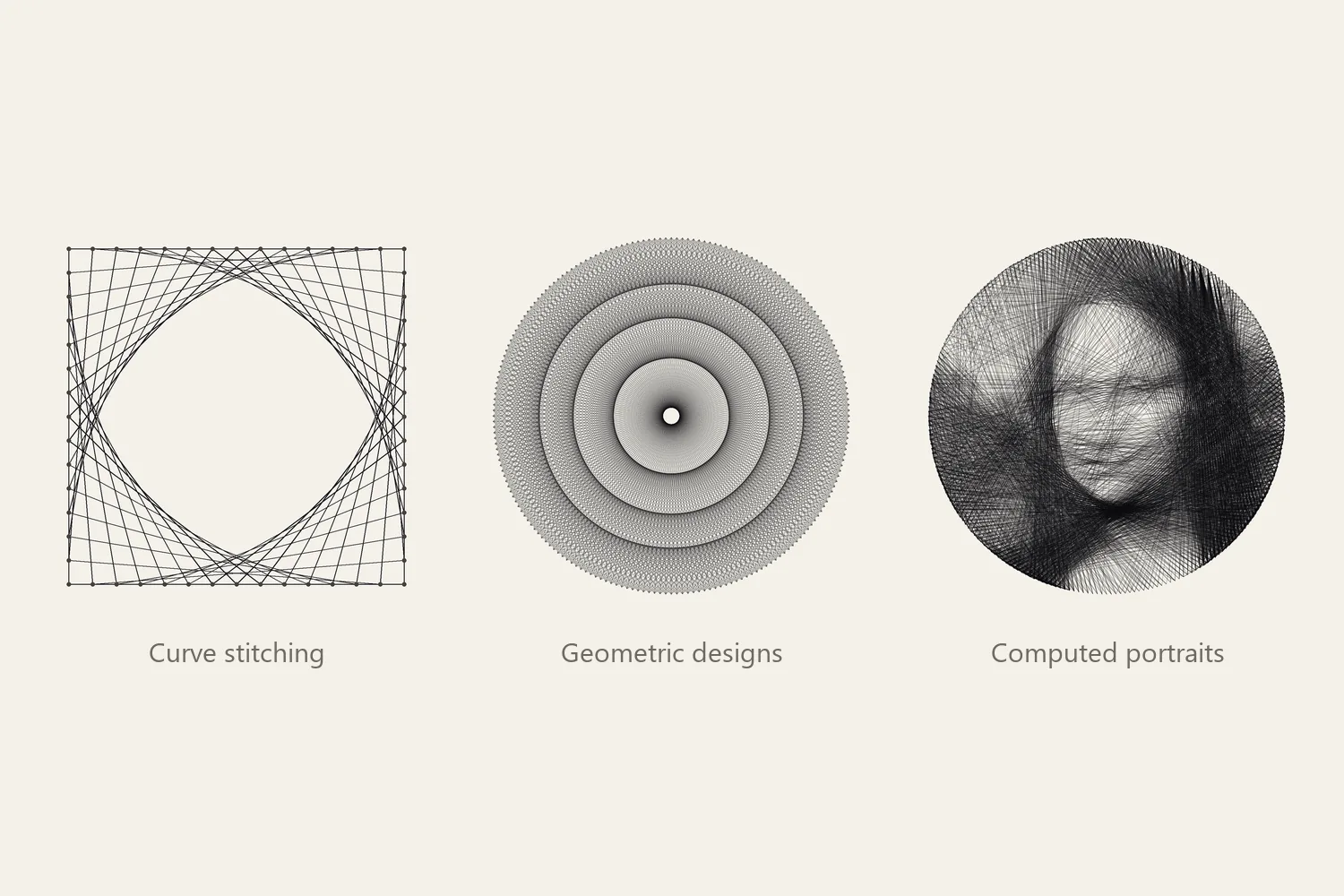
The mathematics behind it is the envelope: a curve that touches every line in a family of straight lines. Joining equally spaced points on two edges gives a parabola. Joining points on a circle by a doubling rule gives a cardioid. Our curve stitching guide shows how to make both.
The craft boom
In the late 1960s and the 1970s, string art left the classroom and went onto living room walls. Kits and books taught people to hammer nails into painted or velvet-covered boards and wind bright thread or wire between them in stars, spirals and sailing ships. Books such as Lois Kreischer’s Symmography (1971) treated the geometry as design. Many households still remember the look: bold envelopes of colour on a dark background.
Thread in modern art
Artists used stretched lines for other reasons. Naum Gabo’s Linear Construction in Space series builds open forms from nylon monofilament stretched over clear Perspex, so the lines describe space rather than fill a surface. More recently, Gabriel Dawe’s Plexus installations stretch thousands of coloured threads across rooms, where they read as beams of light. The techniques page collects these references with links to their sources.
Computer-planned portraits
In 2016 the Greek artist Petros Vrellis presented A new way to knit: portraits made from a single thread wound around 200 pegs on a 28-inch circular frame. A custom program turned a photograph into a sequence of pegs, the thread ran from peg to peg 3,000 to 4,000 times, and the total length reached one to two kilometres. The pieces were wound by hand, following instructions dictated by a computer.
The work showed that a photographic image could be built from nothing but straight lines between points on a circle, and it inspired many makers and programmers to write their own pattern generators. Vrellis also worked with Erik and Martin Demaine on a string art font, in which letters are traced by thread paths.
String art today
Today the two traditions meet. Geometric pieces are still made for the joy of the curves, and portraits are planned by software and wound by hand. A generator like this one does the planning: it chooses a continuous route through the nails that approximates the light and dark of your photo. The guide to how the generator works explains the method. The winding is still yours, one nail at a time.
Put it into practice
Try your image, inspect the preview, and save the pattern that works for your project.
Open the generator