
Real numbers from real patterns
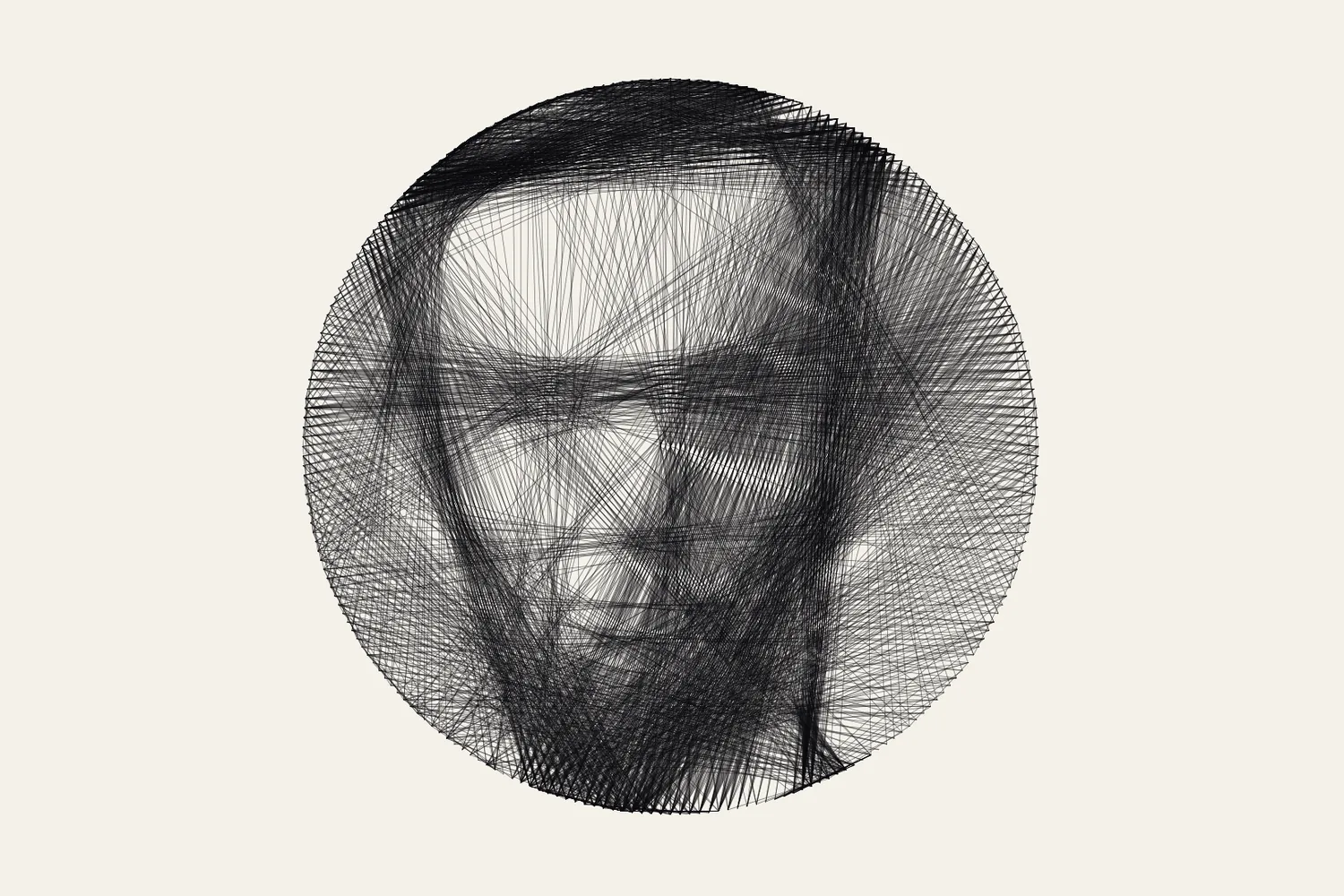
Thread length is the question most people ask before their first piece, and the honest answer is that it depends on the pattern. These are the lengths of the sample portraits in the studio, each planned on a 50 cm board with 240 nails. The length is the straight distance from nail centre to nail centre along the whole route.
| Sample | Connections | Thread |
|---|---|---|
| Nikola Tesla | 2,739 | 781 m |
| Abraham Lincoln | 2,341 | 822 m |
| Albert Einstein | 3,144 | 948 m |
| Marie Curie | 3,829 | 974 m |
| Mona Lisa, one thread | 2,805 | 1,042 m |
More connections do not always mean more thread. The Lincoln pattern has fewer connections than Tesla but uses more thread, because more of its lines cross the full width of the board. Across these samples, the average connection was between half and three quarters of the board width.
Board size changes everything
Every line crosses the board, so thread length grows in proportion to board size. The same pattern on a 25 cm board needs half the thread; on a 1 m board it needs twice as much. That makes a quick estimate possible before you generate anything:
thread ≈ connections × 0.6 × board width
For 3,000 connections on a 50 cm board, that is 3,000 × 0.6 × 0.5 m = 900 m. Treat the result as a first guess. The studio calculates the exact route length once the pattern exists, and that figure is the one to buy from.
Add an allowance
The route length covers the straight spans only. The real thread also wraps around a nail at every connection, and a few millimetres per wrap adds up over thousands of nails. Knots, tails, a test on an offcut and the occasional unwound mistake take more. The studio’s “Thread to buy” figure adds 15% to the route length for all of this.
Keep a little more in reserve if you are new to winding or if your nails are thick. Running out three connections from the end is far more annoying than having half a spool left over.
Buy from one batch
Thread is sold by length on the label, sometimes in yards (1 yard is 0.914 m). Buy everything you need at once, and check that every spool comes from the same dye batch if the label shows one. Two spools of the same colour name can differ in shade or thickness, and a change halfway through a portrait shows as a band of different tone.
The thread you buy should also match the thickness you set in the studio. A thicker thread than planned makes the piece darker than the preview; a thinner one makes it lighter. The materials guide explains how to test a thread before committing to it.
Colour patterns
In a colour pattern each thread has its own route and its own length. The colour Mona Lisa sample uses five threads on a 50 cm board with 280 nails, between 184 m and 316 m each and 1,160 m in total. Buy each colour separately with the same 15% allowance. The lengths differ a lot between colours, so do not divide the total evenly.
Put it into practice
Try your image, inspect the preview, and save the pattern that works for your project.
Open the generator